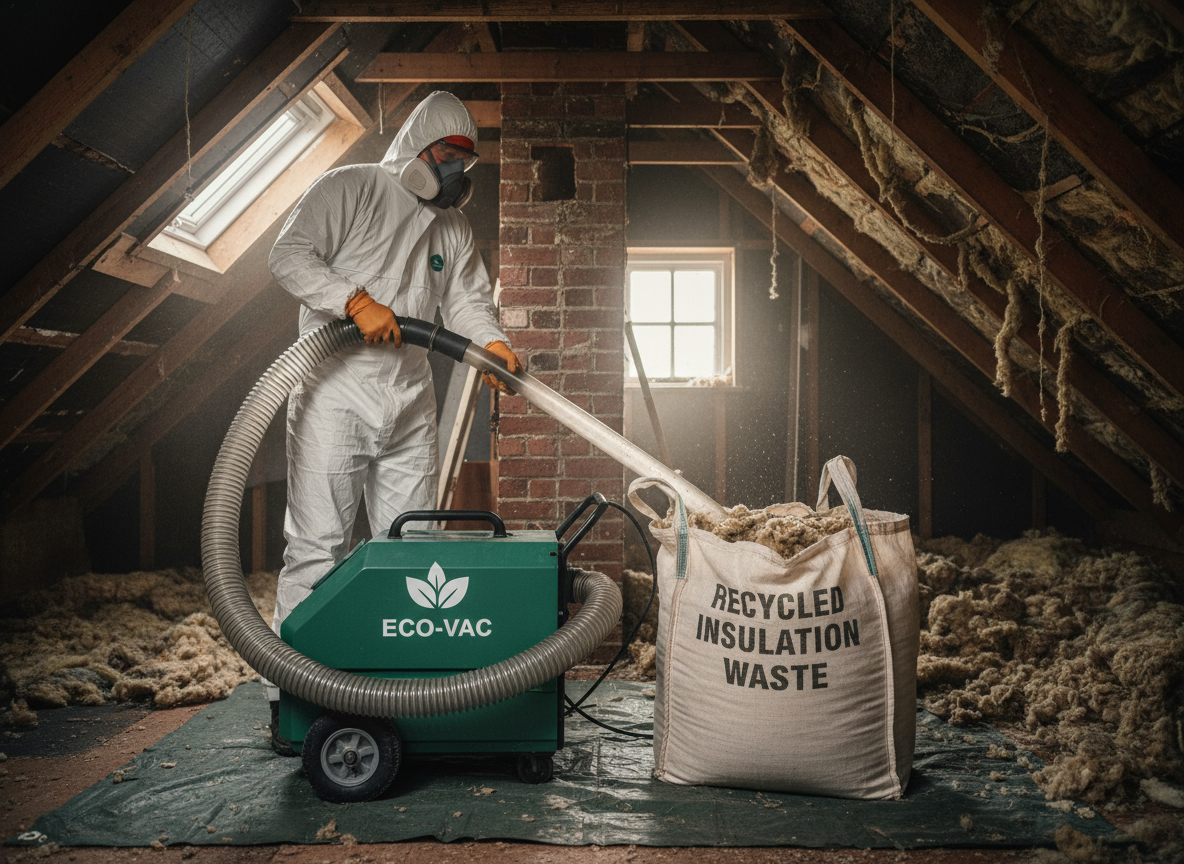
Stafford properties, particularly those built between the 1930s and 1970s around Tipping Street and the town centre, frequently contain spray foam applied directly to rafters or cavity walls. Over time the material degrades, traps moisture, and restricts airflow in lofts. Environmentally friendly removal requires mechanical extraction rather than solvents, combined with sealed containment to prevent particles from entering living spaces. Staffordshire's frequent rainfall and older brick construction mean hidden damp is common behind the foam, so every job begins with a moisture assessment to avoid structural damage during extraction.
The process demands careful sequencing because Stafford's terraced and semi-detached housing stock often has limited loft access and shared party walls. Loose-fill or closed-cell foam must be broken down in sections while negative air pressure is maintained. Disposal follows strict waste regulations; the removed material is bagged on site and taken to licensed facilities rather than general landfill. Homeowners in the Stafford area sometimes attempt partial removal themselves, which leaves residue that continues to off-gas and attract mould once the remaining foam is exposed to the county's humid conditions.
Edge cases include foam that has bonded to electrical cabling or pipework in post-war bungalows on the outskirts of Stafford. These require hand removal around services rather than aggressive scraping. After extraction, ventilation checks are performed to confirm the roof space meets current building standards for airflow, preventing future condensation problems that are especially prevalent during Staffordshire winters.
Technician insight
In Stafford, the thing that catches most people out with environmentally friendly insulation removal is the older cavity wall construction around the town centre and Tipping Street, where decades of wet Staffordshire winters cause the foam to bond tightly to damp brick. Homeowners often underestimate how much hidden moisture sits behind the material and end up with rot once the foam is gone. We always run a moisture meter first because skipping that step turns a straightforward extraction into a much larger repair.
Loft Foam Removal in a 1950s Stafford Semi
Problem: Spray foam in a loft was blocking ventilation and causing condensation on a property near Staffordshire Place. What we found: Closed-cell foam adhered to rafters with trapped moisture from repeated winter rainfall. What we did: Set up full containment, extracted the foam mechanically in sections, and disposed of it at a licensed facility. Outcome: Loft returned to proper airflow with no residue left behind.
How it works
- 1
Initial Assessment
Inspect the property to map foam locations, check for moisture, and identify access constraints typical in Stafford housing.
- 2
Containment Setup
Install sealed barriers and negative air machines to keep particles out of living areas during removal.
- 3
Mechanical Extraction
Break down and remove foam using specialist equipment without chemical solvents, bagging material on site.
- 4
Site Clearance and Disposal
Remove all residue, clean surfaces, and transport waste to licensed facilities for environmentally responsible handling.
- 5
Final Verification
Conduct moisture and ventilation checks to confirm the space is left safe and compliant.
Pricing
Cost varies with foam depth, access difficulty, and property type; upfront quotes provided after inspection.