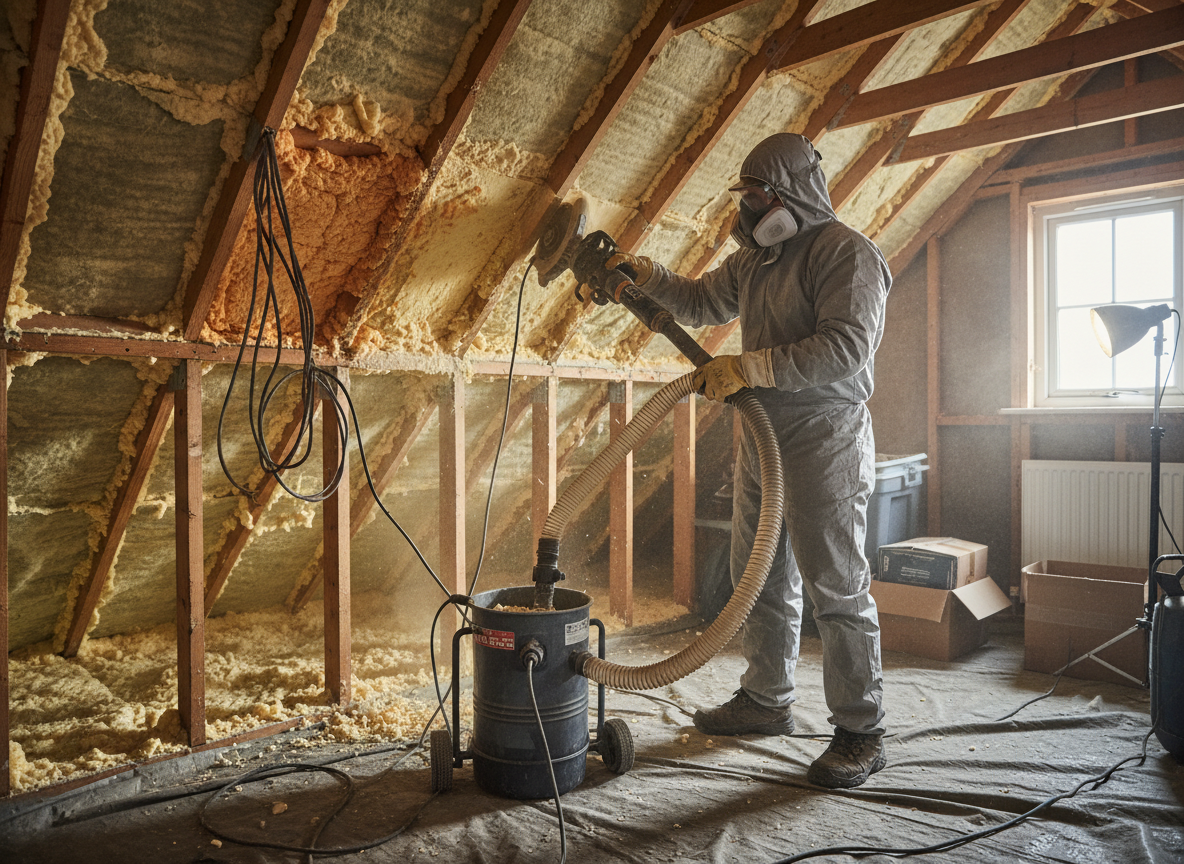
Spray foam installed in Stafford properties from the 1970s onward often traps moisture against brick and timber frames common in Victorian terraces around the town centre and post-war estates in Baswich. Over time this leads to rot in roof timbers and reduced airflow in lofts that were never designed for sealed insulation. Removal requires careful mechanical scraping and vacuum extraction to avoid damaging original lath and plaster ceilings below.
Staffordshire's frequent rainfall and high humidity accelerate foam degradation, particularly where properties sit on clay soils that hold water around foundations. Homeowners in areas like Doxey and Castlefields frequently discover foam that has absorbed groundwater vapour, creating hidden mould colonies. Technicians must cut ventilation slots during extraction and monitor for hidden damp proof course breaches that only appear once the foam is gone.
Edge cases in Stafford include listed buildings near the Shire Hall where foam was applied over original features without listed building consent. Removal here demands hand tools and dust containment to satisfy conservation officers. Modern injected foam in cavity walls along the A34 corridor also requires different solvent handling than older open-cell products to prevent residue staining on external brickwork.
Code compliance in the Stafford area means following current Building Regulations Part L and C when reinstating ventilation after foam removal. Failure to restore adequate eaves and ridge ventilation can leave properties non-compliant and prone to condensation once the foam is gone.
Technician insight
In Stafford, the thing that catches most people out with Residential Spray Foam Removal is how often the foam was pumped straight over blocked or missing eaves vents in Victorian terraces around the town centre. Once removed you discover years of trapped condensation that has already started softening joist ends, and the job suddenly becomes a timber repair as well as insulation removal.
Doxey Semi with Hidden Loft Foam
Homeowner noticed musty smell and peeling ceiling paper in a 1930s semi. Survey found 150 mm of closed-cell foam covering original lath and plaster with no ventilation left. Foam was mechanically removed in sections, eaves vents cleared, and new ridge ventilation added. Property now meets current airflow requirements and condensation issues stopped within weeks.
How it works
- 1
Initial Loft and Cavity Survey
Technicians inspect roof voids, cavity walls and any accessible voids in Stafford properties to map foam depth, adhesion points and any hidden timber damage.
- 2
Containment and Dust Control
Plastic sheeting and negative air machines isolate work areas, protecting carpets and furnishings common in period homes around the town centre.
- 3
Mechanical Removal and Extraction
Foam is cut and scraped in sections, then vacuumed out with HEPA filtration to limit airborne particles in older, draughty properties.
- 4
Ventilation Restoration and Final Clean
Eaves, ridge and soffit vents are cleared or reinstated, followed by a full site clean and moisture check before handover.
Pricing
Cost depends on property age, foam thickness and access difficulty. Upfront quotes provided after survey.