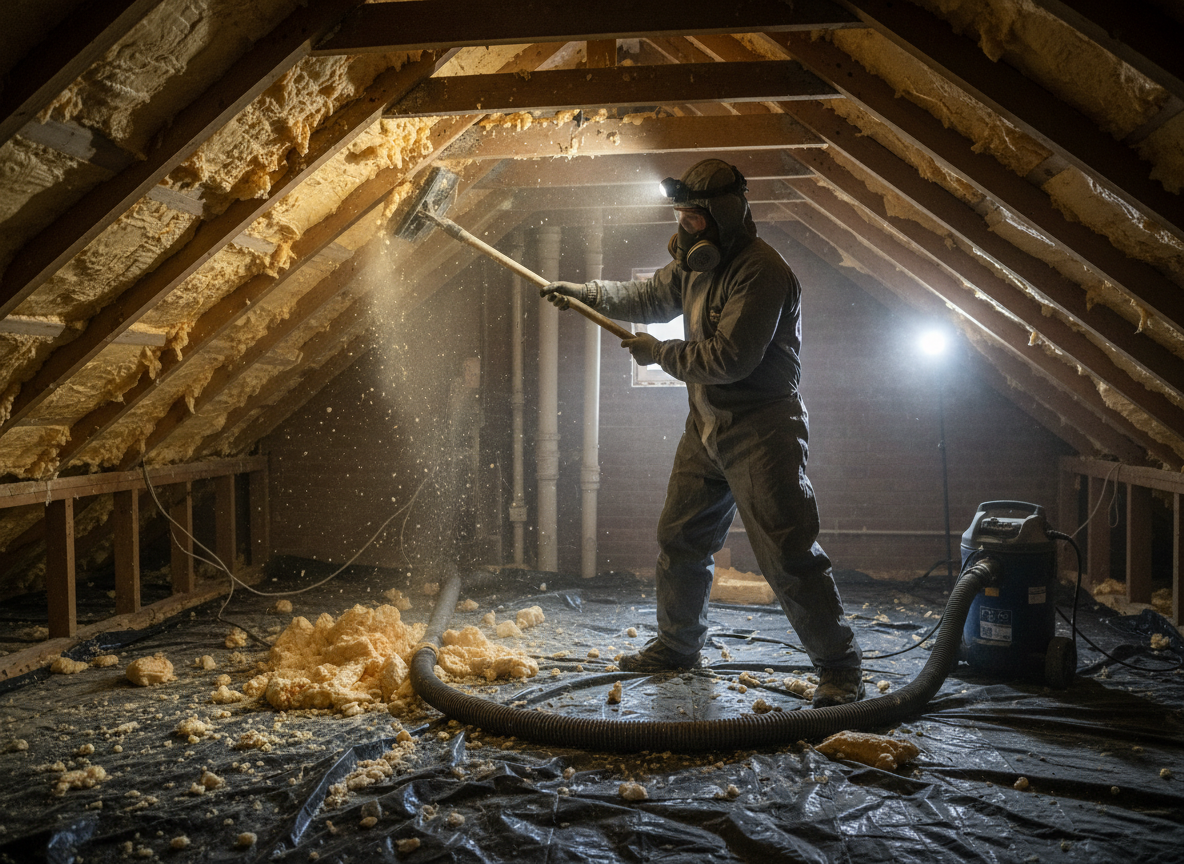
Spray foam installed in Stafford lofts often traps moisture against timber joists in Victorian terraces and 1960s semis common around Tipping Street and the town centre. Removal requires cutting back the foam in controlled sections to avoid disturbing asbestos-containing artex ceilings or disturbing original lath and plaster walls that still exist in many side streets off Lichfield Road. Proper extraction also means checking for hidden electrical cables and pipework that run through the foam in these older builds, where original wiring was never intended to be encased.
Staffordshire weather brings frequent damp spells that can leave residual moisture in roof voids long after the foam is gone. Technicians must ventilate the space immediately and install temporary ridge and eaves vents to prevent mould returning on rafters. In properties near the River Sow, ground levels and poor drainage mean extra care is needed when working in ground-floor extensions where foam was applied to walls, as water ingress from the rear gardens can undermine new insulation plans.
Homeowners in Stafford often discover that spray foam has filled every gap around chimney breasts and party walls, creating hidden voids that only appear once cutting begins. Safe removal involves sequential stripping, bagging waste on site, and HEPA vacuuming to capture fine particles before they settle into the rest of the house. Final inspection checks that original breathable materials have not been damaged and that the loft can now meet current ventilation standards without the foam layer.
Technician insight
In Stafford, the thing that catches most people out with Spray Foam Removal near me is how often the foam has been pumped right up against the original brickwork in 1930s semis around the Doxey and Holmcroft estates, trapping damp that then migrates into the joist ends once the foam is stripped.
Loft Clearance in Central Stafford Terrace
The homeowner reported a persistent musty smell in a mid-terrace house off Tipping Street. Inspection showed spray foam completely filling the loft void and touching the chimney stack. We cut the foam back in sections, removed all residue, and added ridge ventilation. The space dried out and the smell disappeared within weeks.
How it works
- 1
Site Assessment
Survey the property in Stafford to map foam locations, check access points, and identify any hidden hazards in the roof or walls.
- 2
Containment Setup
Seal work areas with sheeting and negative pressure to keep dust contained while working in terraced homes near the town centre.
- 3
Foam Extraction
Cut and remove the polyurethane in manageable sections, bagging waste immediately to prevent spread throughout the property.
- 4
Cleanup and Ventilation
Vacuum residues, clear debris, and restore airflow with appropriate vents suited to Stafford's typical roof constructions.
- 5
Final Check
Inspect the cleared space for remaining foam, moisture issues, or damage before handing the area back to the owner.
Pricing
Pricing depends on property age, foam depth, and access constraints typical in Stafford terraces and semis.